

Puerta de Almocábar in Ronda
This gate has witnessed eight centuries of dramatic history. The name itself tells a story—”Almocábar” comes from the Arabic “Al-Maqabir,” meaning “the cemetery”, because a Muslim burial ground once lay just outside these walls.
- Attractions
- Puerta de Almocábar
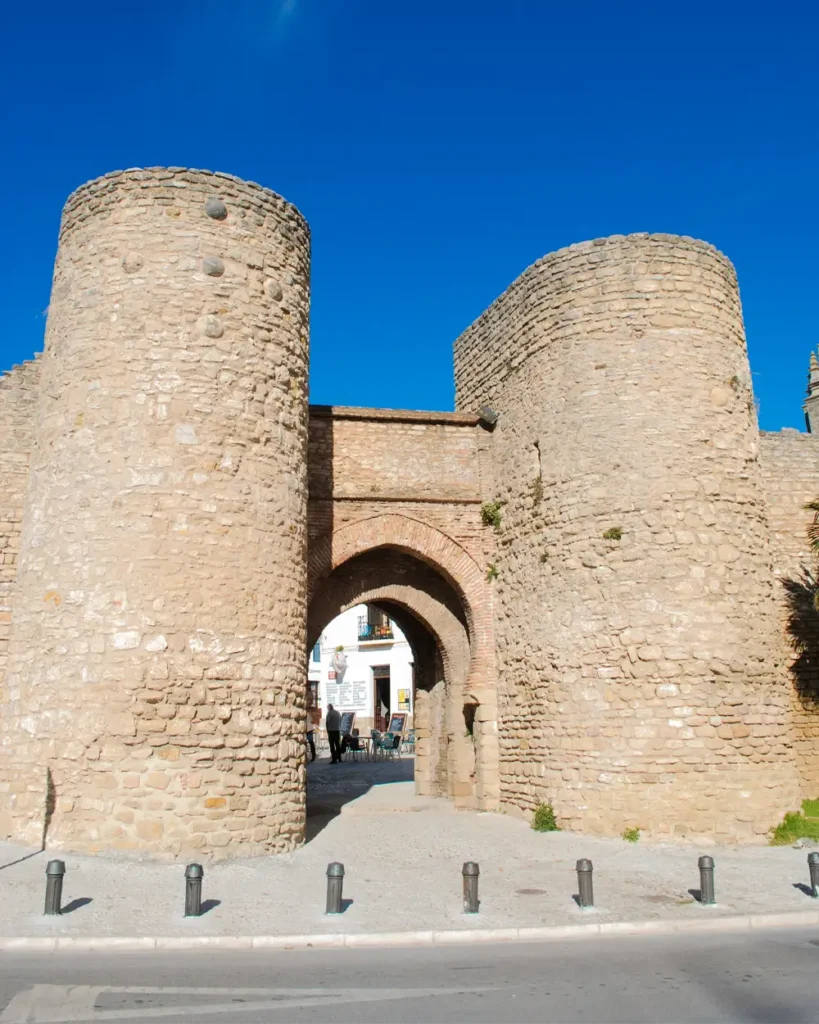
The strategic heart of medieval Ronda
Built in the 13th century during Moorish rule, the Puerta de Almocábar wasn’t just a gate—it was Ronda’s main line of defense on the vulnerable southern side. The Muslims knew exactly what they were doing when they fortified this spot. Unlike the northern side, where the dramatic El Tajo gorge provided natural protection, this southern approach was the city’s Achilles’ heel. That’s why you’ll find this impressive complex of three successive gates flanked by two semicircular towers that once housed the garrison.
What strikes me every time I visit is how massive these walls are. When you stand before them, you can almost hear the echoes of soldiers’ footsteps along the ramparts. Those towers weren’t just for show—they served as living quarters for guards and housed the mechanisms for opening and closing the gates. Imagine the responsibility of being the soldier who had to decide who gets in and who stays out.
Two gates, two eras
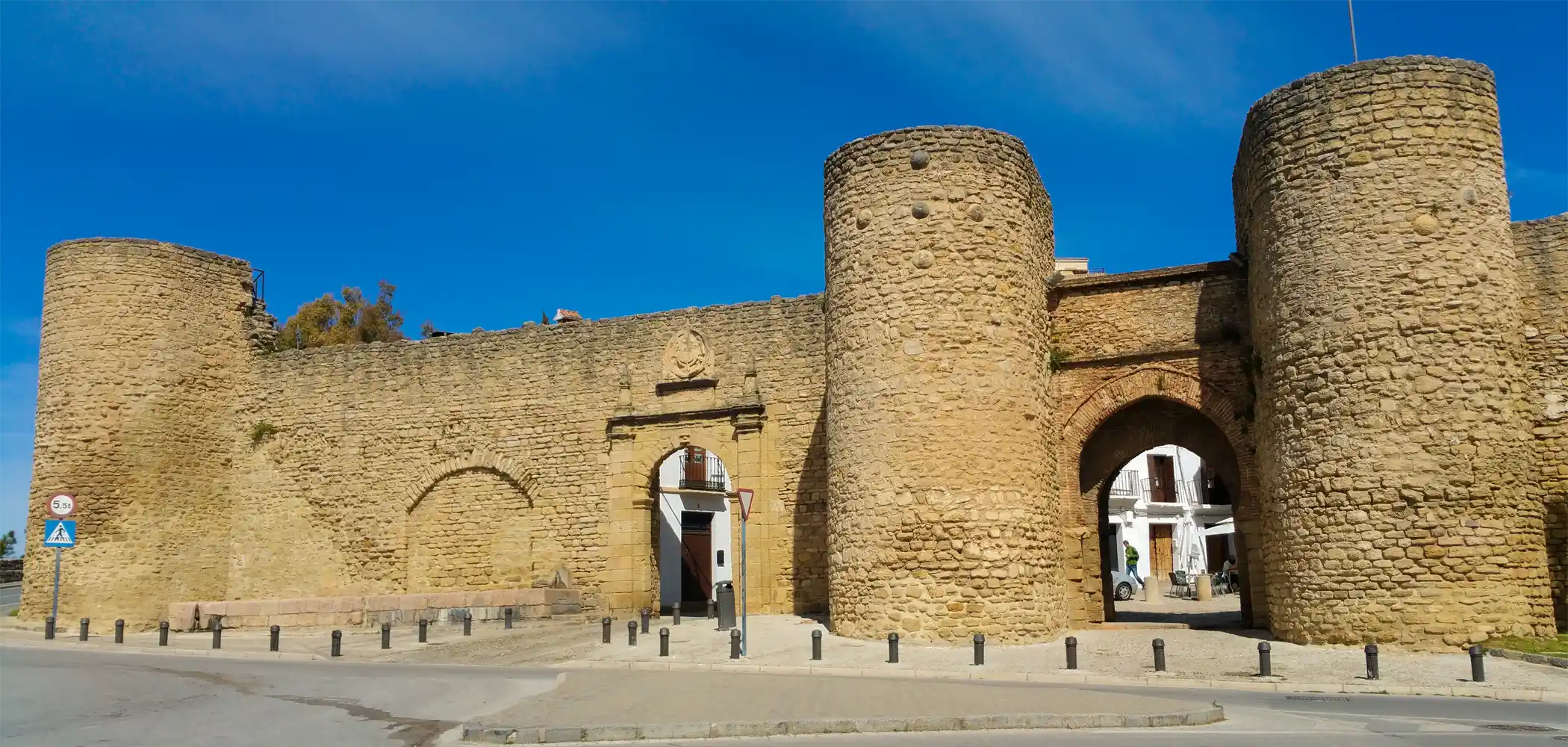
Now, here’s something many visitors don’t realize—there are actually two gates here, and people often confuse them. The Puerta de Almocábar, on the right, is the original 13th-century Moorish gate, easily recognizable by its distinctive horseshoe arches that are quintessentially Islamic in style. Right next to it, just a few meters away, stands the Puerta de Carlos V, added in the 16th century with its Renaissance flair and the imperial eagle crest of the Spanish Empire.
I always tell visitors to take a moment to look at both gates side by side. It’s like reading Ronda’s history in architecture—from Moorish elegance to Spanish imperial grandeur, all in one glance. After the Reconquista, the complex was renovated in Renaissance style, which is why you’ll see that wonderful blend of Islamic and Christian architectural elements.
Best time to visit
Early morning, before 10 AM, when you’ll likely have the place to yourself and the light is perfect for photography. Or late afternoon, around 6 PM in summer (5 PM in winter), when the setting sun creates that magical golden glow on the ancient stones and locals start their evening paseo.
The day that changed everything
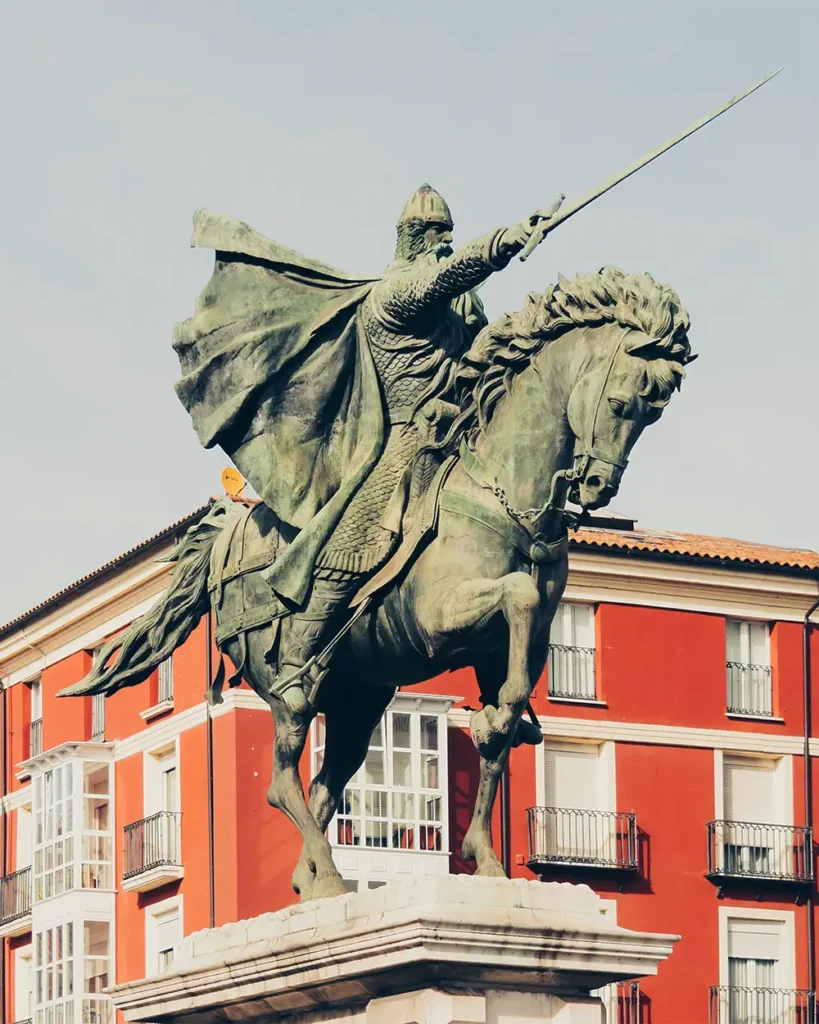
Here’s where things get really interesting, and this is a story that still gives me goosebumps. On May 20, 1485, King Ferdinand the Catholic marched his troops through these very gates, ending 800 years of Moorish presence in Ronda. But how did he manage to conquer a city that had been considered nearly impregnable?
The answer lies in one of the most brilliant military deceptions in Spanish history, and you can still see evidence of it today. Walk through the Almocabar Gate and cross to the other side where the Iglesia del Espíritu Santo stands. Look carefully at the church’s exterior wall, and you’ll spot something curious—a horseshoe nailed upside down, pointing in the opposite direction a visitor would walk.
This horseshoe commemorates Ferdinand’s masterstroke of military strategy. In 1485, during the Reconquista, the Catholic Monarchs learned that the Moorish forces led by Hamet el Zegrí were conducting raids on Medina Sidonia and Cádiz. Ferdinand saw his opportunity. He ordered his blacksmiths to reverse the horseshoes on 3,000 horses stationed in the region. When his cavalry moved, their tracks suggested they were fleeing from Ronda toward Loja, not approaching it.
The Moors fell for it completely. They moved their artillery from Ronda to defend Loja, leaving Ronda’s defenses critically weakened. Ferdinand immediately brought all his artillery from Coín and Cártama—cities he’d already conquered—and laid siege to Ronda. The encirclement was total: Las Peñas, Las Huertas del Tajo, El Predicatorio, Barrio Río Grande, Los Tejares—every approach was covered. Thanks to those backwards horseshoe prints, Ronda fell in just four days.
Can you imagine? Eight hundred years of Moorish rule ended because of some cleverly reversed horseshoes. That’s the kind of historical drama you’re standing in the middle of when you visit the Puerta de Almocábar.
The secrets most tourists miss
Climbing the towers
Here’s something that surprises almost everyone: you can actually climb up onto the walls and towers, and it’s completely free. Most people walk past, snap a photo from Plaza Ruedo Alameda across from the gate, and move on. They have no idea that those stone steps lead up to some of the most spectacular views in Ronda.
I discovered this almost by accident years ago, and now it’s one of my favorite spots in the entire city. From up there, you can walk along the ramparts, peer through the ancient battlements, and see the town from a completely different perspective. You get sweeping views of the surrounding Andalusian countryside, the whitewashed buildings of the old town, and the mountains beyond. At sunset, when golden light hits the ancient stone, the scene becomes absolutely magical. The best part? While masses of tourists crowd around the Puente Nuevo, you might have this entire section of wall to yourself.
The towers themselves are fascinating to explore. You can still see the rooms where guards once slept, the arrow slits they used for defense, and the worn stone steps they climbed countless times each day. Running your hand along those walls, smooth from centuries of touch, connects you to history in a way that’s hard to describe.
The fountain that served an empire
On the exterior of the wall complex, look for the Fuente de la Muralla de Almocávar—also called El Pilón. This isn’t just any fountain; it’s a piece of Ronda’s economic history. This watering trough marked the beginning of a royal cattle path (cañada real), where knights would stop to water their horses and livestock. Over time, it became integrated into the city’s urban water supply system.
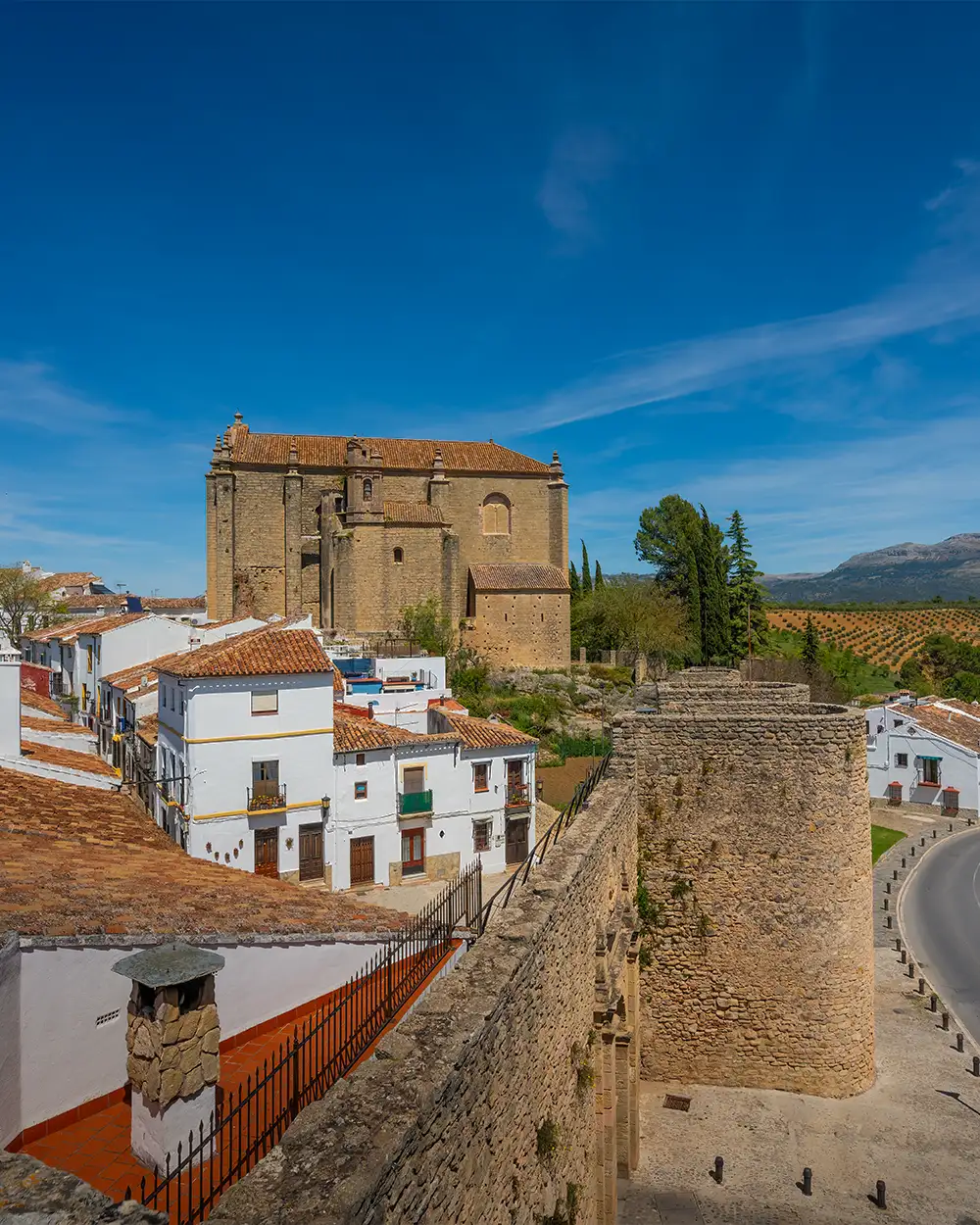
Behind the gates
Step through the Almocabar Gate, and you enter another world. Behind it rises the Iglesia del Espíritu Santo, a powerful church that literally stands on the foundations of history. It was built shortly after the Reconquista, deliberately placed to dominate the space once held by Muslim structures. In front of you opens the Plaza de San Francisco, where Ferdinand’s Castilian troops gathered on that fateful day in 1485.
This area is actually one of the quietest parts of Ronda since most tourism concentrates around the Puente Nuevo and the pedestrian street Calle Espinel. That’s precisely why I love it here. You can wander the narrow streets of the old Moorish quarter, pop into authentic tapas bars frequented by locals rather than tour groups, and experience Ronda as it actually is, not as the postcard version.
The streets beyond the gate maintain that Islamic layout—narrow, winding lanes designed to confuse invaders and provide shade from the Andalusian sun. Now they’re lined with Renaissance mansions built by the powerful families who accompanied Ferdinand in the conquest. It’s this layering of cultures, one on top of another, that makes Ronda so endlessly fascinating.
Connecting with Ronda's other treasures
From the Puerta de Almocábar, you can easily continue exploring Ronda’s fortifications. Walk north along the path that follows the eastern walls—you’ll pass the Murallas de Levante and eventually reach the spectacular Arab Baths near the old Roman bridge. The entire walk traces Ronda’s defensive perimeter and offers continuously changing views of the gorge and countryside.
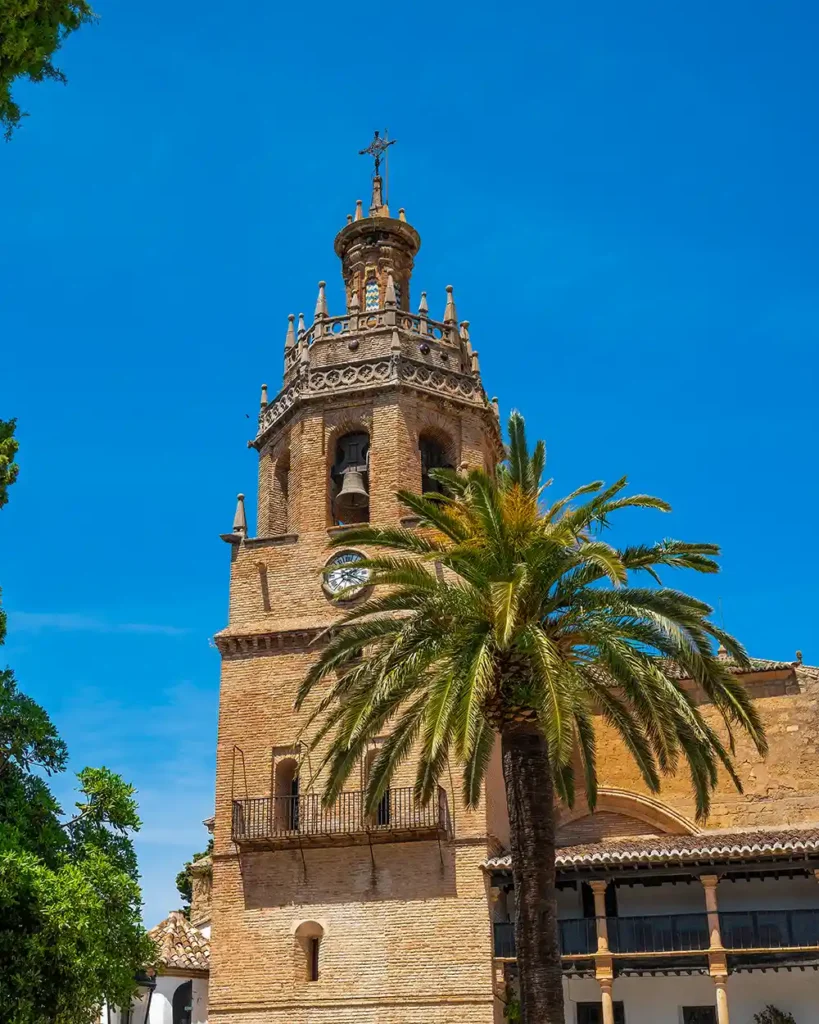
Alternatively, head into the heart of the old town through the gate. You’re now in what was the Islamic medina, and everything you see from here—the layout of streets, the placement of buildings, the flow of water—was designed by Moorish engineers and urban planners. The Mondragón Palace, the Church of Santa María la Mayor (built on the site of the main mosque), and the Plaza Duquesa de Parcent are all within easy walking distance.
Frequently asked questions
Why visit the Almocábar Gates?
Look, Ronda has no shortage of incredible sights. The Puente Nuevo rightfully draws crowds. The bullring has its place in history. But the Puerta de Almocábar represents something deeper—it’s the physical threshold between Islamic Al-Andalus and Christian Spain, between medieval warfare and Renaissance peace, between the Ronda that was and the Ronda that became.
Every time I walk through these gates, I think about all the people who’ve done the same over 800 years: Moorish merchants leading pack mules, Christian knights on horseback, farmers bringing produce to market, refugees fleeing war, pilgrims seeking shelter, lovers meeting secretly, and now travelers like you, seeking to understand this remarkable city.
The stones remember all of it, even if they can’t speak. But if you’re quiet and patient, and you let yourself really be present in this place, you might just hear the echoes.
How do I get to the Puerta de Almocábar from the Puente Nuevo?
It’s about a 10-minute walk downhill. Head down Calle Armiñán for approximately 700 meters until you see the walls and gates at the bottom. It’s an easy, pleasant walk with good signage, though remember it’s uphill on the way back.
Can I walk on the walls at the Puerta de Almocábar, or is it just viewable from the ground?
Yes, you can absolutely climb up and walk along the ramparts and towers! It’s one of the best-kept secrets in Ronda, and unlike many historical sites, it’s completely free to access. The stone steps lead up to the battlements where you can enjoy panoramic views of the town and countryside.
What's the difference between the Puerta de Almocábar and the Puerta de Carlos V?
They’re two separate gates standing right next to each other. The Puerta de Almocábar (on the right) is the original 13th-century Moorish gate with characteristic horseshoe arches. The Puerta de Carlos V is the Renaissance-style gate added in the 16th century with the Spanish imperial eagle crest. They represent two different eras of Ronda’s history.
Is parking available near the Puerta de Almocábar?
Parking in this neighborhood is very difficult and limited. It’s better to park near the Puente Nuevo area or at one of the public lots in the new town, then walk down. Alternatively, local buses stop at Plaza Ruedo Alameda right in front of the gate.