

El Tajo Gorge in Ronda
The thing about El Tajo de Ronda is that everyone sees it, but most people only see it from above. They snap their photos from the bridge, maybe wander to one viewpoint, and move on. But this gorge deserves so much more of your time.
What Makes El Tajo Special?
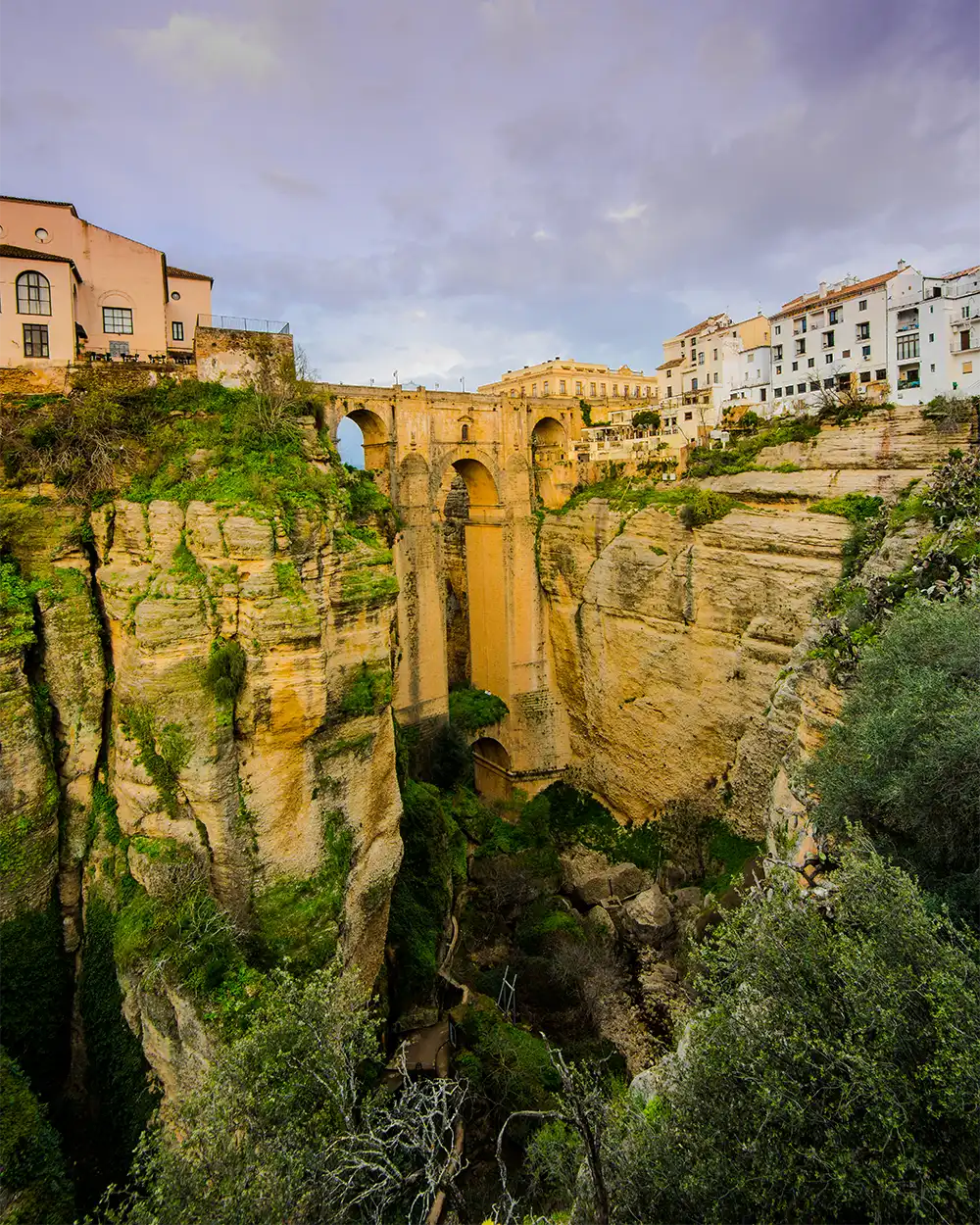
El Tajo isn’t just a gorge—it’s the reason Ronda exists where it does. The name comes from Arabic, “tajo” meaning cut or cliff. When you see how dramatically the Guadalevín River (from the Arabic “Wadi-al-Laban,” meaning “river of milk”) has sliced through the rock over 65 million years, you understand why every civilization that passed through here was utterly captivated.
The gorge divides Ronda into two distinct parts: the Moorish old town (La Ciudad) and the newer mercantile district (El Mercadillo), connected by the magnificent Puente Nuevo that took 42 years to build and cost over 50 workers their lives during construction.
What really gets me is the geology. This isn’t just any rock—it’s Jurassic limestone mixed with calcarenites (sandy limestones with marine fossils), part of the Betic Cordillera formed when Africa collided with Europe. In 2019, the Tajo de Ronda was declared a Natural Monument of Andalusia—official recognition of what locals have known for centuries. Walking along the rim, you can actually see the layers of sediment, millions of years of history written in stone.
The Best Viewpoints: Where to Actually Stop
Here’s where I take visitors when they want the real Ronda experience, not just the tourist snapshots:
Alameda del Tajo Gardens
Start here. The viewpoint at the end of this park offers what I consider the most complete panoramic view of the gorge and the surrounding countryside stretching toward the Costa del Sol. Best at sunset when the limestone walls glow orange.
Mirador de Aldehuela
Named after the architect who completed the Puente Nuevo, this gives you the classic postcard view. Morning light works best here, with the bridge dramatically framed against the town.
Balcón del Coño
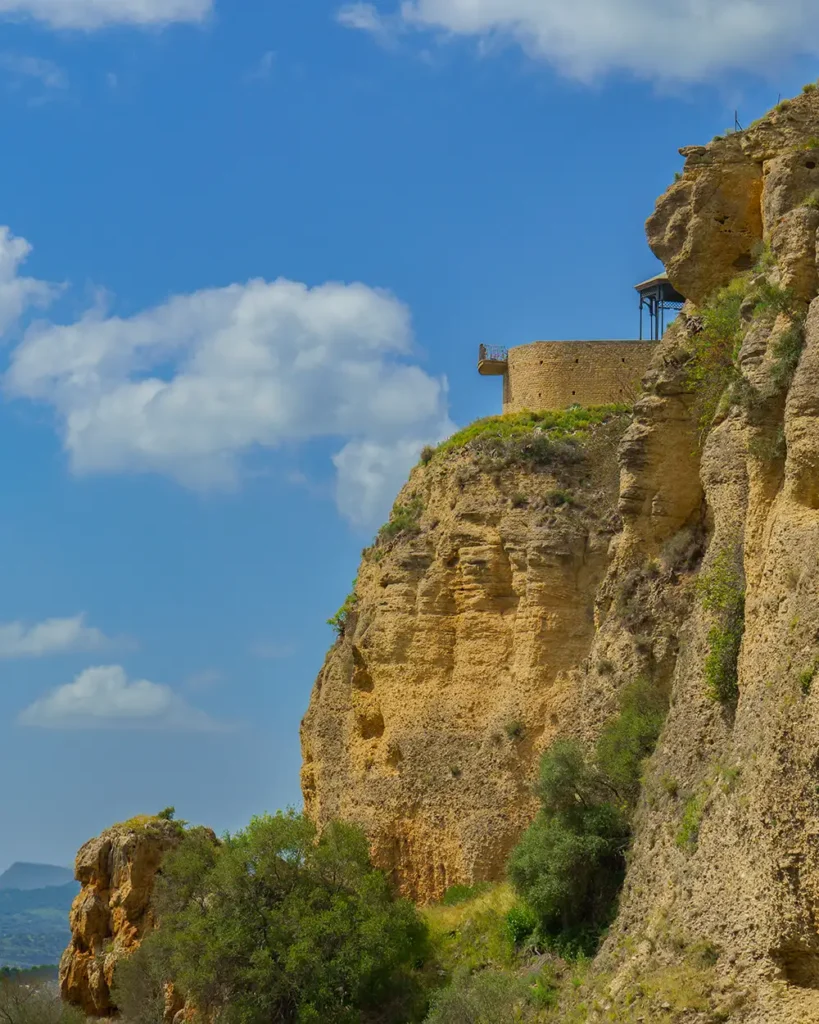
Yes, that’s its real name—nicknamed for the Spanish expletive visitors blurt out when they look down at the vertiginous drop. Located near the Parador, this might be the most dramatic cliff-edge viewpoint in all of Spain. Come at sunset for unforgettable photographs.
The Secret Spot: Jardines de Cuenca
Not many tourists make it here. These hanging gardens on the gorge edge offer intimate views of all three of Ronda’s bridges without the crowds. You feel like you’re suspended between earth and sky. Best in the morning when light fills the gorge.
Arco del Cristo
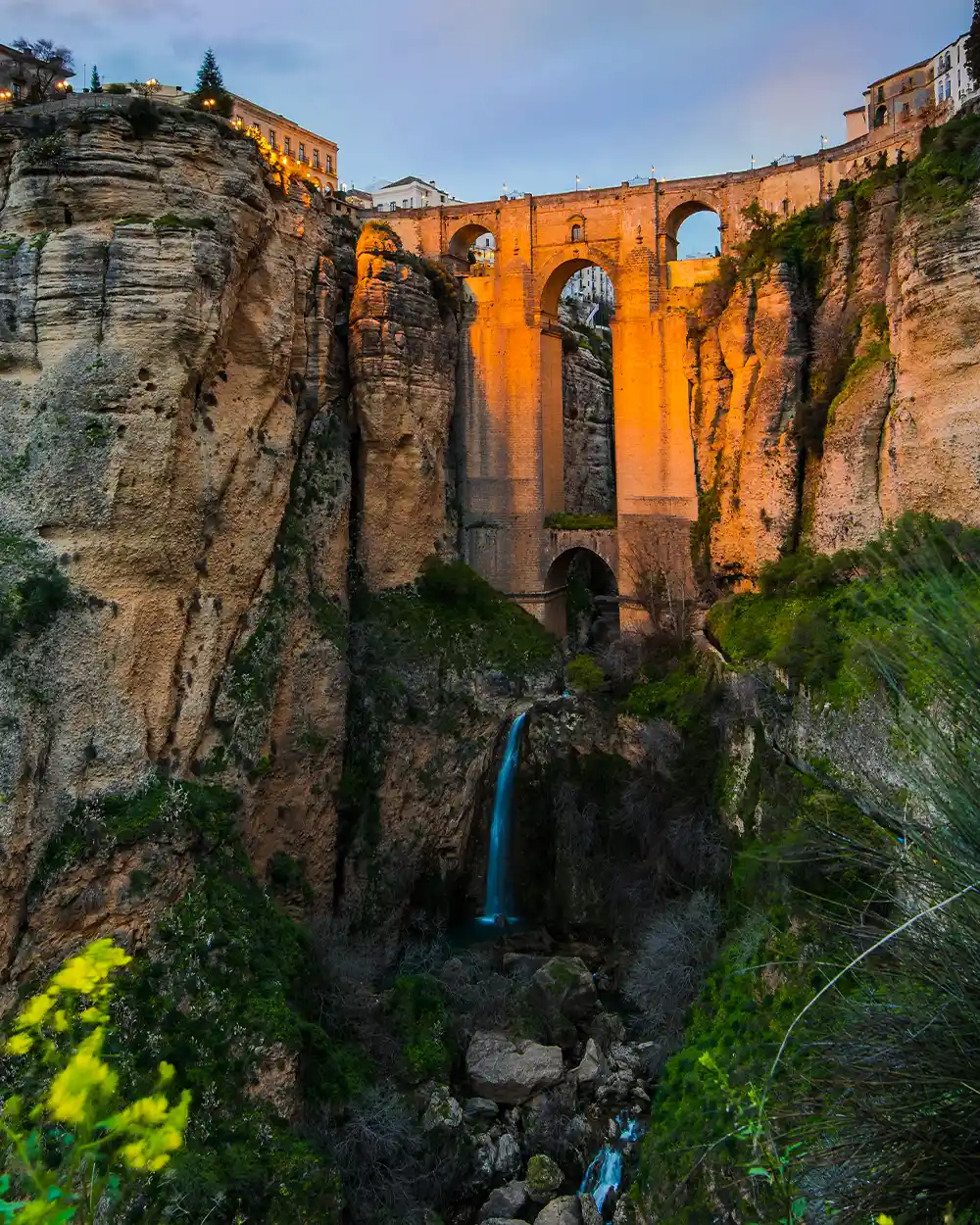
The best angle to capture the gorge with the waterfall. This ancient Moorish gate frames the Puente Nuevo perfectly—and hardly anyone knows about it.
Walking El Tajo: Your Options
The Camino del Desfiladero (Gorge Walkway)
In April 2024, Ronda opened the Camino del Desfiladero del Tajo, and honestly, it’s changed everything. This is the path that workers used when building the Puente Nuevo back in the 1750s—just 250 meters of trail, but it takes you to the heart of the gorge from below.
Starting at Plaza María Auxiliadora, this refurbished path descends to the actual base of the Puente Nuevo. The perspective you get from directly underneath that massive 98-meter bridge? You can’t replicate that from anywhere else. Over 160,000 visitors experienced it in the first year alone.
- €5 per person
- 45min - 1h
- Children under 8 not permitted
Fair warning—the cobbled pathway down is VERY steep. I’ve seen plenty of visitors turn around halfway. If you have mobility issues, this isn’t for you.
The really exciting part? Phase 2 is currently under construction—500 meters of elevated wooden walkways designed by Luis Machuca (the same architect behind the famous Caminito del Rey). As of July 2025, construction is 65% complete with an expected opening in late 2025 or early 2026.
New features will include a suspended bridge hidden inside a cave, walkways anchored directly into the gorge walls, and access to previously unseen rock formations. The full route will connect Plaza María Auxiliadora to the Arab Baths near Ermita de San Miguel—transforming how we experience this natural monument.
Casa del Rey Moro
Want to descend deep into the gorge without the Camino del Desfiladero? The Casa del Rey Moro has a secret: La Mina, a 14th-century staircase carved into the rock that descends 60 meters down to the river through 231 steps cut directly into the cliff face.
It was built during the reign of King Abomelic so the Moorish city could access water during sieges. The stairs are narrow, worn smooth by centuries of feet, and lit by small openings that frame the gorge in ways that’ll make your camera very happy. You can actually reach the Guadalevín River at the bottom.
- €10
- Winter: 10:00 - 20:00 daily
- Summer: 10:00 - 21:30 daily
Via Ferrata: For the Truly Adventurous
If walking seems too tame, there’s a via ferrata—a climbing route with fixed cables and iron steps—that ascends the gorge walls directly beneath the Puente Nuevo. What makes this one special is its history: the original iron steps were installed in 1917 to prevent rockfalls that threatened the historic flour mills below.
Two routes are available:
- La Sevillana: 70-74m length, K1 difficulty (very easy), perfect for beginners
- Escalerilla de la Muerte: 75m length, K2 difficulty, more vertical with small overhangs
Price is around €30 per person including guide, harness, and helmet. Minimum age 6 years or 30kg weight. Duration approximately 40 minutes. Several local companies offer guided excursions including Horizon Naturaleza y Aventura and Al Andalus Activa.
The views of the Puente Nuevo from below are absolutely unique—you’ll pass by the ruins of centuries-old flour mills that once fed the entire city.
The Lost Mills of El Tajo
This is history most visitors never hear about. For centuries, 14 Moorish flour mills operated at the bottom of the gorge, powered by the Guadalevín River. They ground wheat and barley—the foundation of Ronda’s food supply—from medieval times until disaster struck.
The 1917 Catastrophe
On July 11, 1917, a massive rockfall from the Tajo cliffs destroyed three mills, killing 14-16 people including an entire family. Only two children survived—Manuel (11) and José Castillo Vázquez (7).
Here’s the mystery: the municipal records of this incident were cut from the official books and remain missing to this day. Some historians believe the documents may hide evidence that the rockfall was caused by a controlled municipal explosion gone wrong.
Today, most mills lie in romantic ruins covered by vegetation. One has been beautifully restored as the Restaurante Los Molinos—definitely worth a meal with a view. You can walk the SL-A 38 trail (5km, easy difficulty) to explore the mill ruins and the gorge floor.
Getting There
The gorge runs right through the center of Ronda. You can’t miss it. The main viewing points are easily accessible on foot from anywhere in the city center.
The Puente Nuevo: Heart of the Gorge
You can’t talk about El Tajo without talking about the Puente Nuevo, which is really the co-star of this whole show.
The Dramatic History
The first bridge, built in just 8 months in 1735, collapsed in 1741 killing around 50 people—some say just before the May Fair. Spain was in financial crisis, forcing masons to use inferior materials. The disaster shocked the city.
The current bridge took 34 years to build (1759-1793), designed by Domingo Lois de Monteagudo and completed by José Martín de Aldehuela. Local master builder Juan Antonio Díaz Machuca invented revolutionary pulley systems to hoist massive stone blocks from the gorge floor below.
Myth vs. Reality: The Architect's Death
You’ll hear guides say architect Aldehuela threw himself from the bridge. This is completely false. Historical records show he died of natural causes in Málaga in 1802 and was buried in the monastery of San Pedro de Alcántara. The suicide story is romantic fiction—nothing more.
Visit the Interpretation Center
The chamber now houses a small museum about the bridge’s construction and history.
- Price: €2.50 (under 14: free)
- Hours: Monday 10:00-14:00, 15:00-18:00 | Tuesday-Friday 9:30-19:00 | Saturday 10:00-14:00, 15:00-18:00 | Sunday 10:00-15:00
- Tourist Pass: €12 includes 6 monuments
The Hidden Chamber and the Spanish Civil War
There’s a 60-square-meter chamber built into the bridge’s central arch, accessed through a square guardhouse. During the Spanish Civil War (1936-1939), both Republican and Nationalist forces allegedly used it as a prison.
Legend says prisoners were thrown from the windows into the gorge below. Hemingway wrote about it in “For Whom the Bell Tolls”—Chapter 10 describes fascist sympathizers being beaten and thrown from the cliffs of a thinly-veiled Ronda.
However, historian Paul Preston’s research in “The Spanish Holocaust” (2012) concludes there’s “no substance in the claim” that large numbers were killed this way. Most Civil War victims in Ronda were shot in the cemetery. The myth was largely spread by General Queipo de Llano’s radio broadcasts in August 1936.
Still, Hemingway’s novel was banned in Spain until 1969, and the 1943 film with Gary Cooper and Ingrid Bergman wasn’t shown here until 1978.
What Lives in the Gorge?
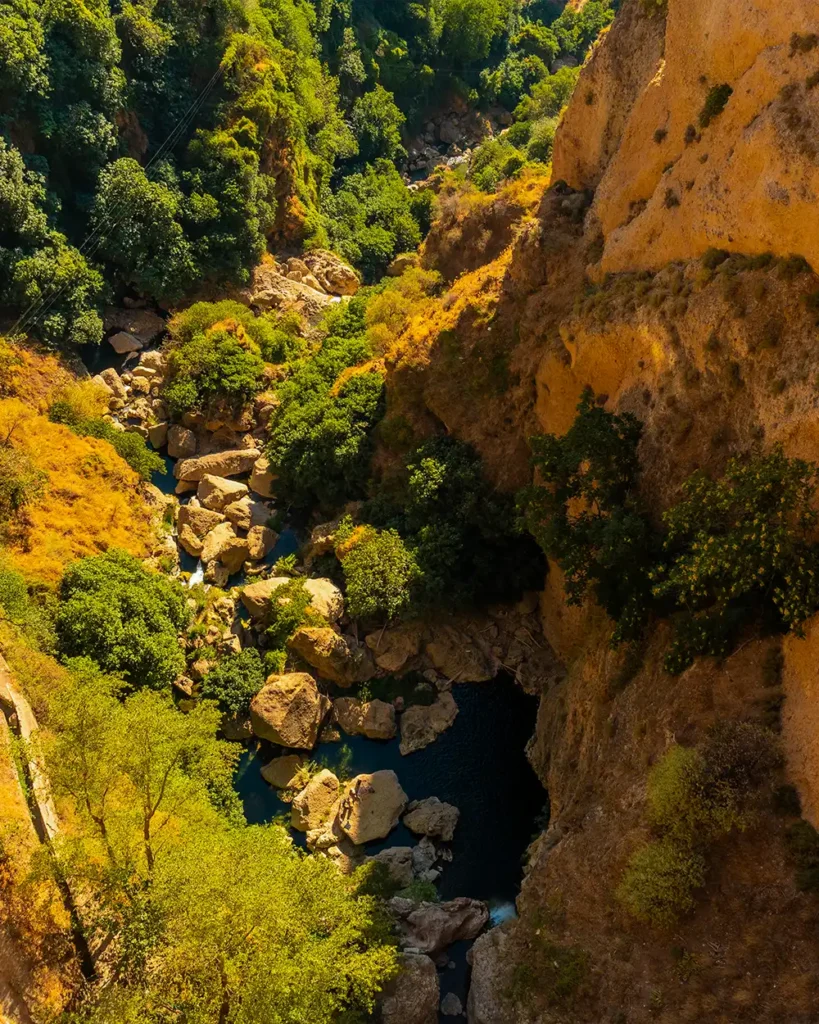
The biodiversity surprises people. You’d think such a dramatic rock formation would be barren, but El Tajo supports an entire ecosystem. I’ve spotted griffon vultures circling overhead, kestrels nesting in the cliff faces, and even the occasional eagle.
Down at river level, especially in the huerta (the famous gardens of the Tajo), there’s lush vegetation—fruit trees, vegetables, herbs. This organic garden has fed Rondans for centuries. As the city’s official chronicler notes, “Ronda has lived from the Tajo, literally.” The water, the livestock grazing, the agriculture—everything came from this gorge.
The flora is specific too, adapted to the microclimate created by the gorge’s depth and the river’s moisture. Though I’ll be honest, there are too many invasive plants right now. The city’s working on recovering the native species, but it’s an ongoing battle.
The Gorge Across Time
Every culture that ruled Ronda left its mark on this gorge. The Celts settled here in the 6th century BC and named it Arunda. The Romans renamed it Ronda and built bridges (you can still see the Roman/Arab bridge downstream from the Puente Nuevo). The Moors came in the 8th century and created most of the Islamic architectural heritage still visible today, including those incredible water mines.
Then came the Christians in 1485, and Ronda transformed again. Each layer of history is visible if you know where to look—in the Arabic arches, the Christian churches built on mosque foundations, the 19th-century additions.
During the 1800s, the gorge was famous (or infamous) for bandits and smugglers who used it as a hideout. Today, thankfully, there are no bandits—just breathtaking views and the occasional peacock cry echoing off the walls.
Frequently asked questions
How deep is the Tajo de Ronda gorge?
The gorge reaches approximately 120 meters (nearly 400 feet) at its deepest point where the Puente Nuevo crosses. The bridge itself stands 98 meters above the river. Width is around 68 meters at the widest point, with the gorge stretching about 500 meters in length.
Can you walk to the bottom of the Ronda gorge?
Yes, through several routes. The safest is the Camino del Desfiladero (€5 ticket required) or via Casa del Rey Moro’s 231-step staircase (€10). Informal paths exist to river level through the old mill area, but these aren’t maintained and should only be attempted with local knowledge.
Is the Camino del Desfiladero worth the money?
For €5, you get a unique perspective directly beneath the Puente Nuevo that you simply cannot get elsewhere. With 160,000+ visitors in the first year, most people agree it’s worth it. The experience will improve significantly when Phase 2 opens in 2026, adding 500 more meters including hidden caves and a suspended bridge.
How long does it take to walk the Tajo gorge?
The current Camino del Desfiladero takes about 45 minutes to an hour including the steep descent and ascent. When Phase 2 completes, the full 750m route from Plaza María Auxiliadora to the Arab Baths will take roughly 90 minutes.
What is the best viewpoint in Ronda?
It depends what you’re after. Alameda del Tajo Gardens offers the most complete panoramic perspective. For dramatic cliff-edge photos, Balcón del Coño is unbeatable. For the classic bridge shot, Mirador de Aldehuela. For fewer crowds, try the Jardines de Cuenca hanging gardens.
Is El Tajo Gorge the same as Caminito del Rey?
No—they’re different locations about 50km apart. El Tajo is in Ronda; the Caminito del Rey is at El Chorro near Ardales. Interestingly, the same architect (Luis Machuca) designed both walkways. Many visitors do both on a multi-day Málaga trip.
Are there vultures in El Tajo?
Yes! The gorge hosts one of Europe’s most important griffon vulture colonies with 600-700+ breeding pairs. You’ll almost certainly see them circling—often below your viewpoint, which is a remarkable experience. Early morning and late afternoon are best for vulture watching.